About Me

Anisha S Menon
I am a Neuroscience Researcher at CSIR-Centre for Cellular and Molecular Biology (CCMB) specializing in CNS axon regeneration. My research focuses on understanding the Epigenetic mechanisms of neural repair and regeneration after injury.
My work combines advanced imaging techniques, single-cell genomics, molecular biology, Animal surgeries and behavioral assessment to develop a comprehensive understanding of neural regeneration processes in adult mouse model organisms. I'm particularly interested in identifying and targeting the intrinsic barriers that could inhibit recovery after spinal cord injury.
When I'm not in the lab, I enjoy science communication and mentoring young researchers interested in neuroscience. I believe in making complex scientific concepts accessible to broader audiences.
What I Do
CNS Axon Regeneration
I work on Central Nervous System (CNS) axon regeneration. Our lab focuses on molecular mechanisms that can effectively promote central nervous system axon regeneration following injury. I investigate the key transcriptional machinery that activates intrinsic regenerative potential, enabling axons in the spinal cord to grow beyond injury sites.
When the spinal cord is injured, the signal that axons carry between the brain and body is halted below the injury site.
How can we regenerate the injured axons?
.png)
Epigenetic Regulation
To activate the genetic programs required for regeneration, the first step is to make these tightly packed chromatin regions more accessible. This allows transcription factors and other regulatory proteins to reach growth-associated genes and switch on the molecular pathways needed for repair. To understand how chromatin is remodeled during this process, we use single-nucleus ATAC sequencing (snATAC-seq) to map chromatin accessibility and CUT&RUN sequencing to examine histone modifications and other epigenetic marks that regulate gene activity.
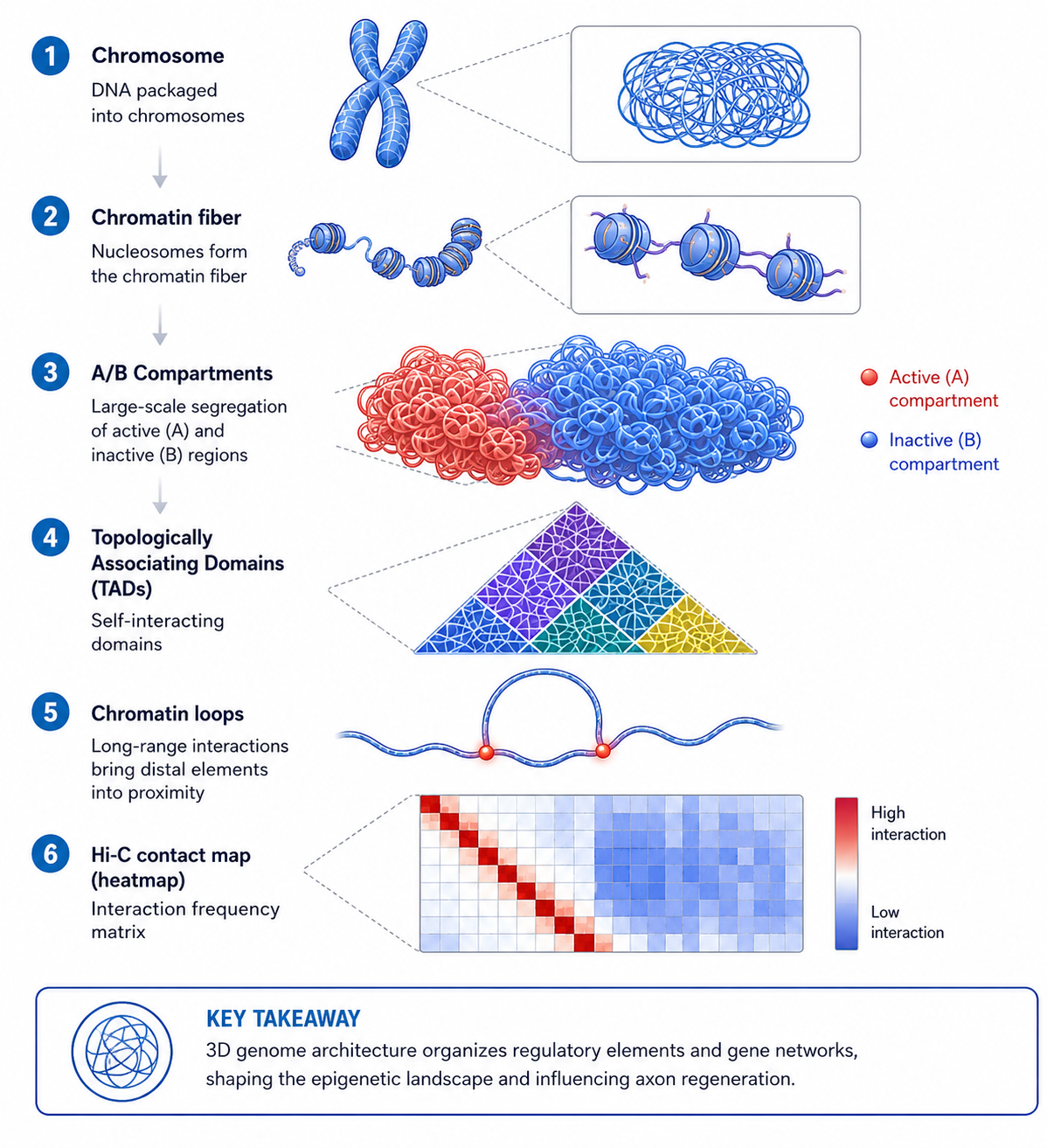
3D Genome Topology
While chromatin accessibility could gate transcription factor binding and gene activation, gene expression is also influenced by how the genome is organized within the nucleus. We investigate how the three-dimensional (3D) architecture of the genome changes following central nervous system (CNS) injury and how these structural changes can be modulated to promote axon growth and regeneration. Using advanced techniques such as Hi-C, we map genome-wide chromosomal interactions to understand how 3D genome organization regulates the activation of regenerative gene programs.
How I Do?
Molecular Biology
Proficient in techniques such as qPCR, cloning, Western blotting, and immunohistochemistry to investigate molecular mechanisms of neural regeneration.
Mouse Injury Model
Expertise in spinal cord injury models, Stereotaxic Injections, and behavioral assessment methodologies to evaluate recovery after CNS injury.
Single Cell Genomics
Experience with single-cell RNA, ATAC, Cut & Run, Hi-C sequencing to identify cell-type specific responses to injury and potential therapeutic targets.
Cell Culture
Skilled in primary neuron cultures, maintenance of neural cell lines, and in vitro models of axon growth and regeneration.
Imaging
Trained in confocal microscopy to assess spinal cord regeneration and brain signals. Expertise in fluorescence imaging and 3D reconstruction of neural tissues.
Bioinformatics
Computational analysis of genomic data, pathway analysis, and visualization of complex datasets related to neural regeneration.
Awards & Publications
Preprints
-
Rewiring of the Three-Dimensional Genome Encodes Regenerative Potential in the Adult Central Nervous System
doi.org/10.64898/2026.03.12.711224 -
PATZ1 Remodels the Nucleosome Landscape to Promote Chromatin Accessibility in Injured Neurons
doi.org/10.64898/2025.12.22.695949 -
PATZ1 Reinstates a Growth-Permissive Chromatin Landscape in Adult Corticospinal Neurons After Injury
doi.org/10.1101/2025.05.14.654166 -
Deep Neurite Analysis Tool (DeNAT): A Machine-Learning Framework for Precise Automated Neurite Outgrowth Measurement
doi.org/10.1101/2025.09.18.676567 -
Nuclear Receptor Transcription Factors Promote Axon Regeneration in the Adult Corticospinal Tract
doi.org/10.1101/2025.06.19.660319 -
Combinatorial Control of Corticospinal Axon Growth by Retinoic Acid Receptors
doi.org/10.64898/2026.07.24.740479
Awards
-
Best Poster Award
-
Second Prize for Best Poster
-
Best Poster Award
Curriculum Vitae
Download my complete CV for a detailed overview of my academic background, research experience, and achievements.
Contact Me
Get in Touch
Email: anisha@ccmb.res.in
Lab: Dr Ishwariya Venkatesh, Venkatesh Lab CSIR-CCMB
Address:
Centre for Cellular and Molecular Biology (CSIR-CCMB)
Habsiguda, Hyderabad
Telangana 500007, India
Feel free to reach out regarding research collaborations, speaking engagements, or questions about my work. I'm always open to discussing new ideas and potential partnerships.