
Here's something that puzzled me for a long time: young neurons can regrow their axons relatively well. Adult neurons, especially in the corticospinal tract — the pathway that carries movement commands from your brain down to your spinal cord — largely can't. The DNA hasn't changed. So what has?
This preprint picks up right where our earlier PATZ1 paper left off, and answers a slightly different question: not just "what opens up growth genes after injury," but "why did those genes get shut in the first place, and can we reverse it?"
.png)
A Developmental Lockdown
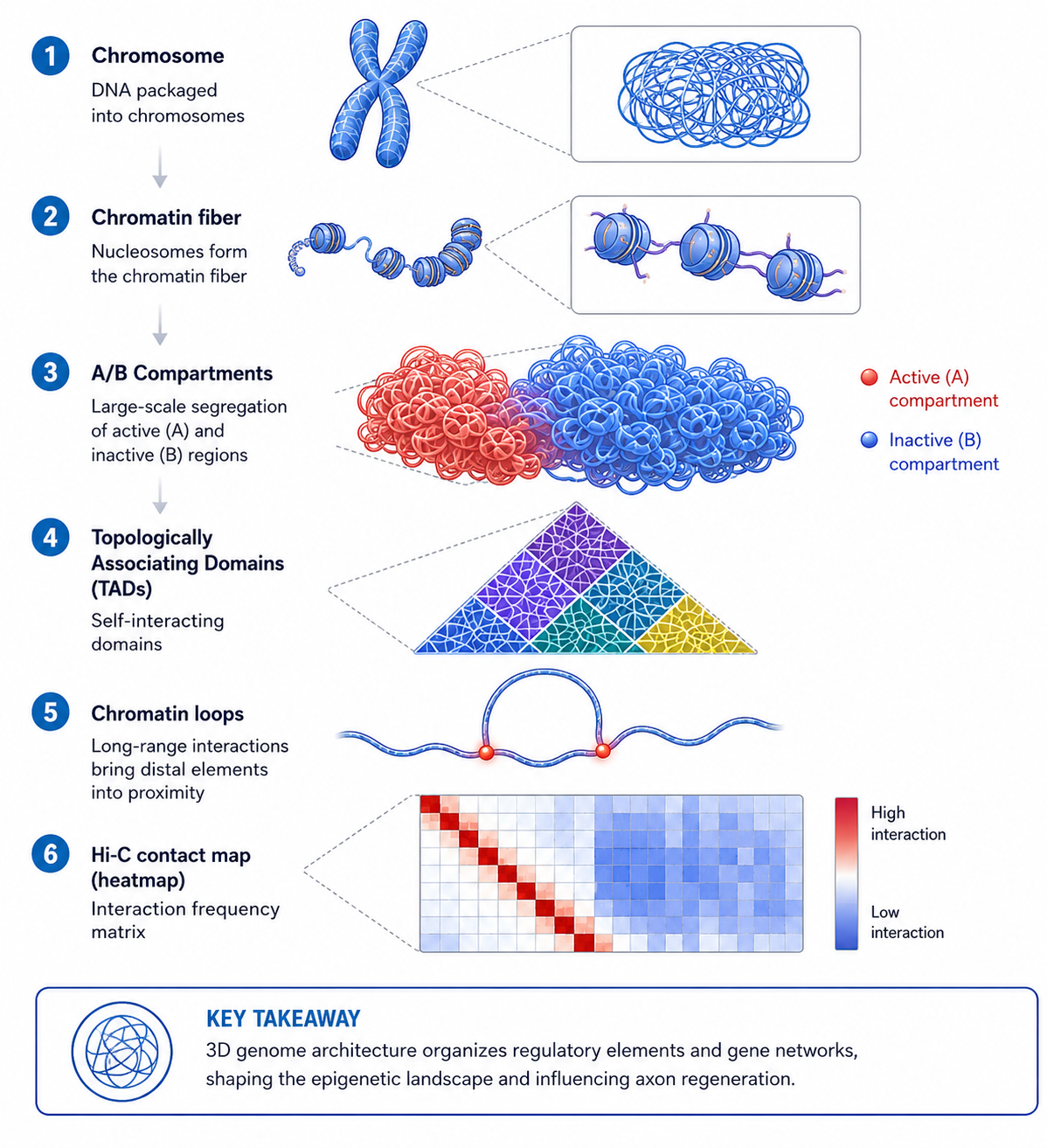
During normal development, once corticospinal neurons finish wiring up the nervous system, many of the genes that drove that initial growth are no longer needed. So the cell locks them away in closed, inaccessible chromatin — essentially archiving instructions it assumes it won't need again. That's efficient for a healthy, mature nervous system. But it becomes a serious problem after injury, when the neuron suddenly does need those growth instructions back, and can't reach them.
A Second Look at PATZ1
We'd already shown that PATZ1 can loosen chromatin packaging at growth-associated genes. Here, we asked a more specific question: can PATZ1 actually reopen the chromatin that development deliberately closed — in the exact neurons responsible for voluntary movement?
What We Found
We traced how chromatin becomes progressively more restrictive at growth genes as corticospinal neurons mature, essentially mapping the "lockdown" as it happens. Then we demonstrated that PATZ1, when active after injury, can reopen this developmentally restricted chromatin — reinstating a growth-permissive landscape in adult corticospinal neurons.
This gives us a mechanistic answer to why adult neurons lose their growth capacity in the first place, and more importantly, evidence that this loss isn't necessarily permanent. It can, at least in principle, be reversed.
Why This Matters
Corticospinal neurons are exactly the cell type you'd want to target for spinal cord injury therapies, since they carry the signals for voluntary movement. Showing that a single factor can reopen their developmentally silenced growth programs makes PATZ1 a genuinely promising therapeutic target — not just a molecule that helps regeneration along, but one that may address the root cause of why these neurons stop trying to regrow at all.
Personal reflection: This project is the closest I've come to answering a question that first pulled me into this field as an undergrad: why can't we do what axolotls and peripheral nerves seem to do so easily? Finding a developmental explanation — and a possible way to undo it — made years of long sequencing runs feel very worth it.

Leave a Comment