
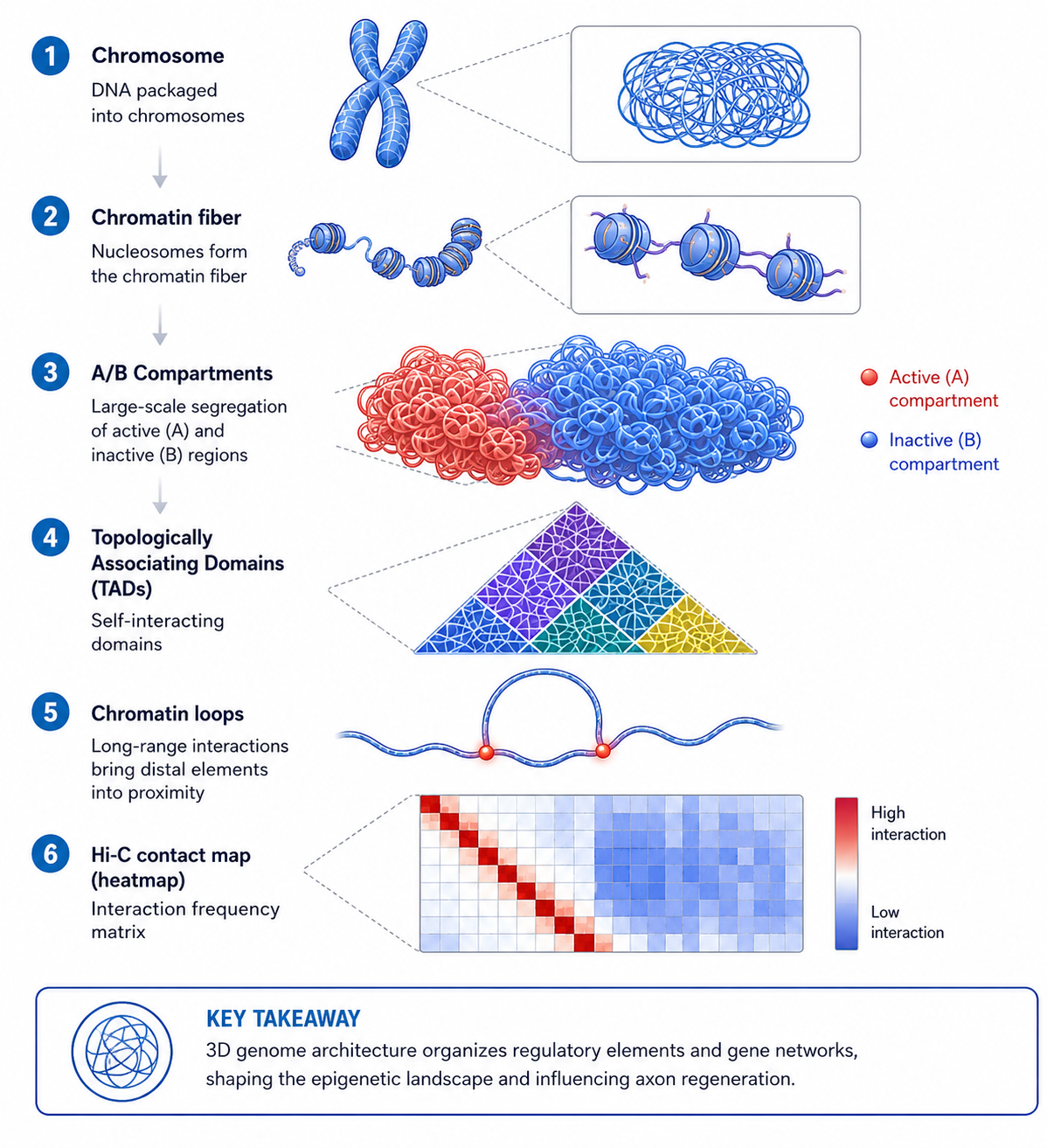
Imagine every gene in your genome is a book on a shelf. Some books sit out in the open, easy to grab and read. Others are shrink-wrapped, stacked tightly, and physically impossible to open without help. That "shrink-wrap" is chromatin — DNA wound tightly around spool-like proteins called histones — and whether a gene is wrapped or open determines whether the cell can read it at all.
In neurons, many of the genes needed for axon growth are shrink-wrapped shut. After an injury, if those genes stay wrapped, regeneration simply can't start — no matter how much the neuron "wants" to regrow. Our latest preprint asks: what actually loosens that wrapping?
.png)
The Problem: DNA Locked Away
Chromatin isn't just packaging — it's a gatekeeper. When DNA is tightly wound into nucleosomes, transcription factors and RNA polymerase (the machinery that actually reads genes) can't physically reach the DNA. The gene might be perfectly intact, but functionally, it's invisible to the cell.
Meet PATZ1
PATZ1 is a protein that can interact directly with chromatin and change how tightly it's packaged. Going into this project, we suspected it might play a role in the injury response of neurons, given hints from earlier data that its activity shifted after CNS damage.
What We Found
We show that PATZ1 remodels the nucleosome landscape in injured neurons, loosening the packaging specifically at growth-associated genes. To see this directly, we used single-nucleus ATAC sequencing (snATAC-seq) to map which regions of the genome became more accessible, and CUT&RUN sequencing to pinpoint the histone marks and other epigenetic signatures that shift alongside PATZ1 activity.
The result was a shift toward what we call a "regeneration-permissive" chromatin state — growth genes that would otherwise stay locked away become physically reachable, right when the neuron needs to switch them on.
Why This Matters
If PATZ1 is one of the keys that unlocks growth-associated genes, that gives us a concrete molecular handle to work with. Rather than trying to activate dozens of individual regeneration genes one at a time, targeting a single upstream remodeler like PATZ1 could, in principle, open up many of the right genes at once — a much more efficient route toward a future therapeutic strategy for spinal cord injury.
Personal reflection: This was the project that first got me hooked on epigenetics. Watching accessibility maps shift at exactly the loci we cared about — and realizing a single protein could be behind so much of that change — was one of those "okay, THIS is why I do this" moments in the PhD.

Leave a Comment