
We tend to picture the genome as a long strand of code, read from beginning to end like a book. But inside the nucleus, that "book" isn't lying flat — it's folded, looped, and crumpled into an intricate three-dimensional shape. And it turns out that shape is not just packaging. It's information.
In our latest preprint, we asked a question that sits right at the heart of my PhD: after a spinal cord injury, why do some neurons manage to switch on a regenerative program while most adult neurons simply can't? Our answer starts not with a single gene, but with the architecture of the genome itself.
Why Shape Matters
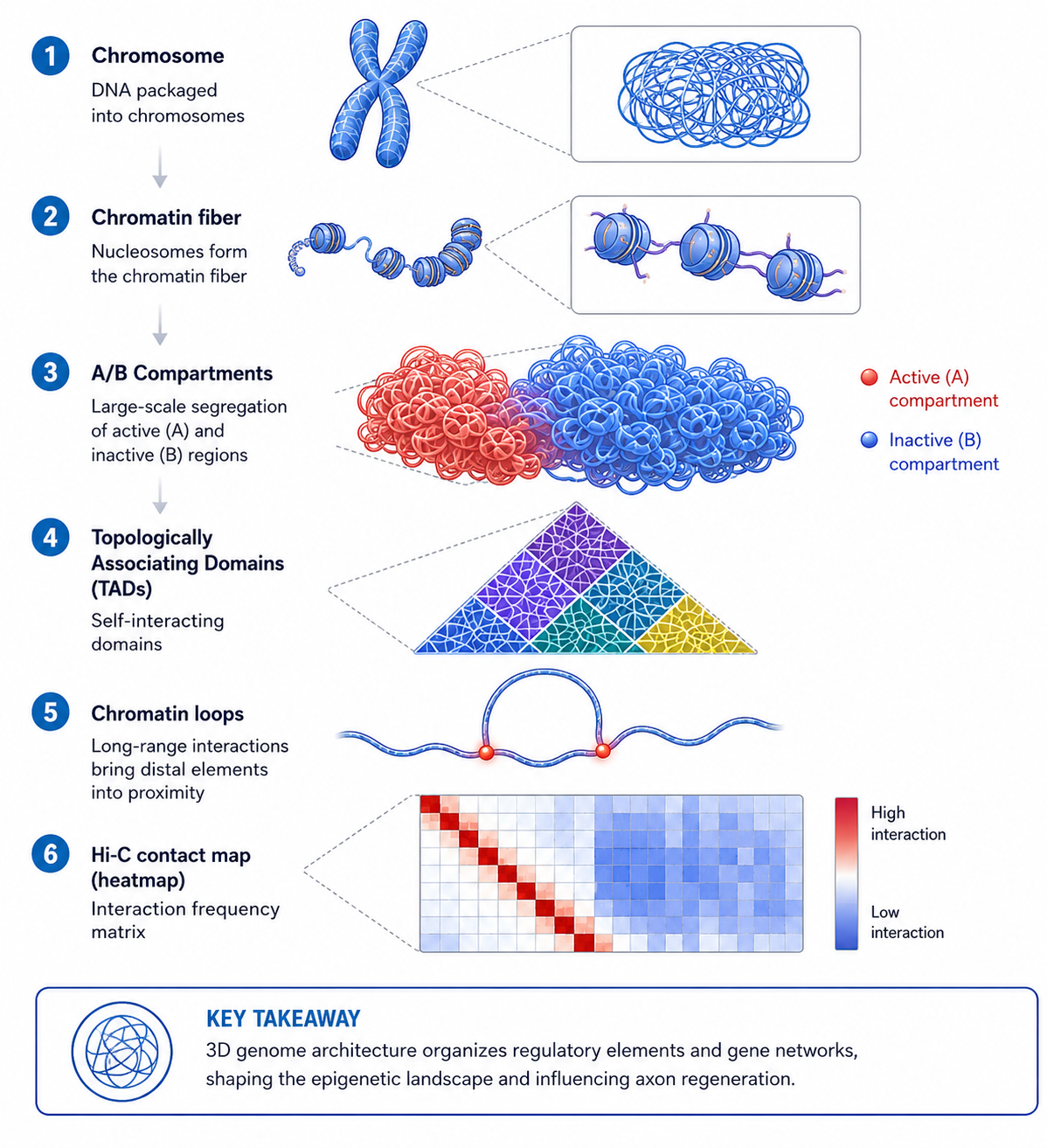
Every cell in your body carries about two metres of DNA, squeezed into a nucleus a few microns across. That's only possible because DNA folds — first around spool-like proteins to form chromatin, then into loops, then into larger neighbourhoods called Topologically Associating Domains (TADs), and finally into even bigger "active" and "inactive" compartments.
This folding isn't random. Genes that need to be read by the cell's machinery tend to sit in open, accessible neighbourhoods. Genes that need to stay silent are tucked away in denser, less accessible ones. So the same DNA sequence can behave very differently depending on where it physically sits in this folded landscape.
Mapping an Invisible Architecture
To actually see this 3D structure, we used a technique called Hi-C — genome-wide chromatin conformation capture. In short, Hi-C freezes the genome in place, then lets us work out which stretches of DNA are physically touching each other, even if they're far apart in the linear sequence. The result is a contact map: a heatmap where "hot" regions tell us which parts of the genome are close neighbours in 3D space.
What We Found
Using Hi-C on adult CNS neurons, we mapped how this three-dimensional architecture is reorganised after injury. What we saw was striking: in neurons that engage their intrinsic capacity to regenerate, growth-associated genes physically move — they get repositioned into more "active," accessible neighbourhoods of the genome. This spatial rewiring isn't a side effect of regeneration; our data suggest it actually encodes the neuron's regenerative potential.
In other words, before a neuron can turn on the genes it needs to regrow an axon, its genome has to reorganise the neighbourhood those genes live in.
Why This Matters
Most work on axon regeneration — including a lot of my own — focuses on individual genes and the transcription factors that switch them on or off. This project pushes the question one level up: what if we could also target the 3D architecture itself? If spatial rewiring is part of what makes regeneration possible, it opens up an entirely different angle for future therapeutic strategies for spinal cord injury — not just asking "which gene," but "where does it need to sit."
Personal reflection: This project genuinely changed how I think about gene regulation. I'd spent years reading about transcription factors switching genes "on" and "off," but seeing the genome's physical shape rearrange itself around injury made the whole process feel a lot less abstract — like watching a city rezone its own neighbourhoods to build something new.

.png)

Leave a Comment